

The colors of literature - Is blue one?
Ah... no!

There is no such thing as blue literature. And yet blue is all around the written world. One colour, two directions: on one side, the blue that descends — the Bibliothèque bleue of Troyes, practical knowledge circulating outside institutional walls, all the way to Wikipedia’s hyperlinks. On the other, the blue that rises — Novalis’s blue flower, the Sehnsucht, the desire for what cannot be reached.
Two blues that never spoke to each other, never even met.
The Bibliothèque bleue is not in the history of literature. Few people have heard of it. And yet, for two centuries, it circulated door to door through the French countryside.
Troyes, 1602. Nicolas Oudot prints small booklets with blue covers: almanacs, lives of saints, tales, remedies, calendars. The paper is made from recycled rags and the quality shows. The texts are often truncated, poorly reproduced, recovered from older manuscripts. Peddlers take to the road to distribute them.
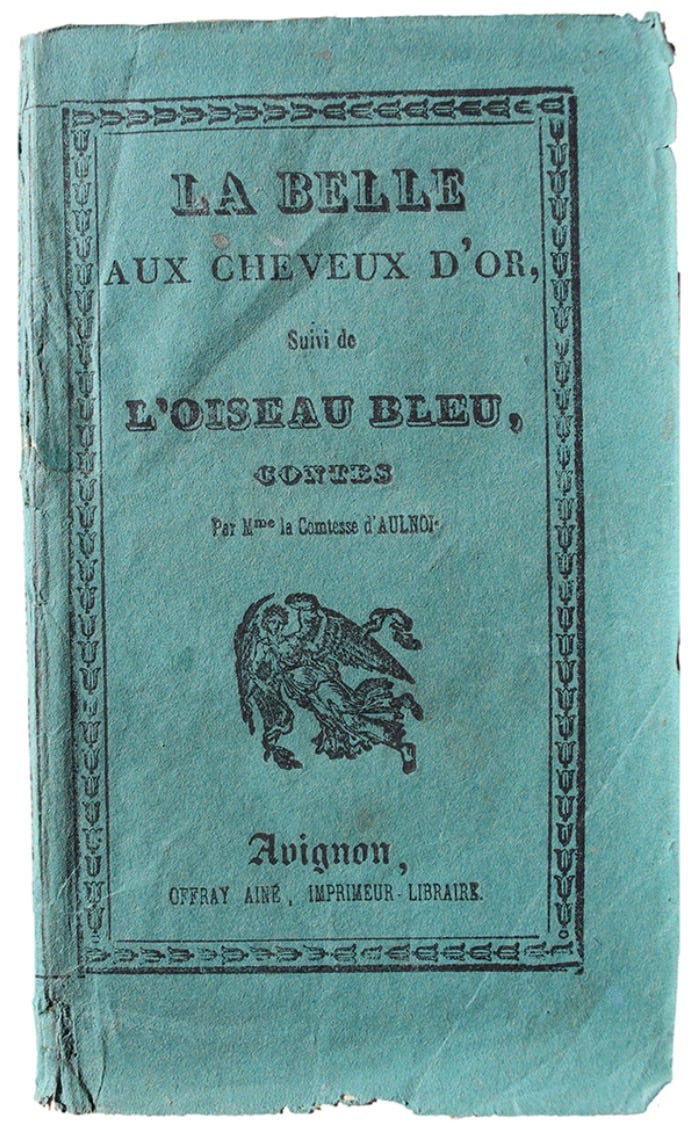
For a century, the authorities look the other way. Then in 1701, restrictions target peddling. An edict of 1757 goes so far as to threaten death to anyone distributing clandestine books.
And people read anyway. Or are read to. The Bibliothèque bleue goes where learned books do not. It arrives, clumsy and approximate, at the thresholds of homes where someone — a priest sometimes, or the peddler himself — reads aloud to the others.
We know that a copy of a peddler’s Christmas carol was found in Marie-Antoinette’s library. The contempt displayed. The secret reading.
What the Bibliothèque bleue transmitted above all was know-how. How to cultivate a plot of land. How to repair. How to heal. A reclaiming of technical knowledge by those the institutions never trained.
But there is another kind of lack. One that cannot be resolved through knowledge, gesture, or use. A lack that no longer points to what one does not know how to do, but to what one cannot be.
This is where blue changes direction. And becomes romantic.
This rising blue does not come from nowhere. Since the twelfth century, the Virgin has carried it. The romantics inherit it.
In 1774, Goethe publishes The Sorrows of Young Werther. The hero loves a married woman. But it is not only her he cannot have — it is a way of existing in the world that is denied to him. He will die from it. The novel triggers a wave of suicides across Europe. The desire for the unattainable pushed to its limit.
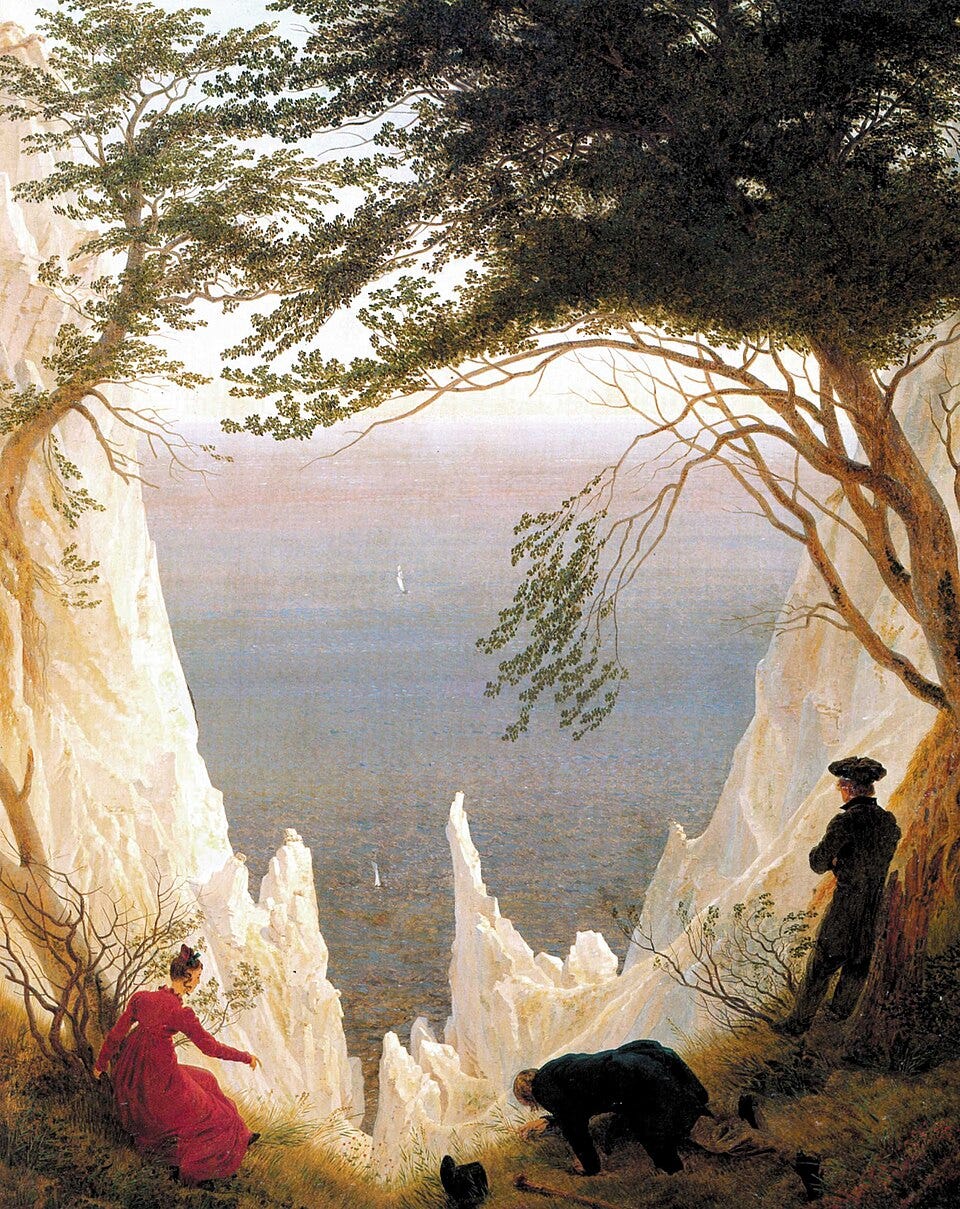
Caspar David Friedrich paints the same thing. His figures are always seen from behind, facing the horizon, the sea, the mountains. We never see their faces. Only what they are looking at, that horizon they cannot reach.
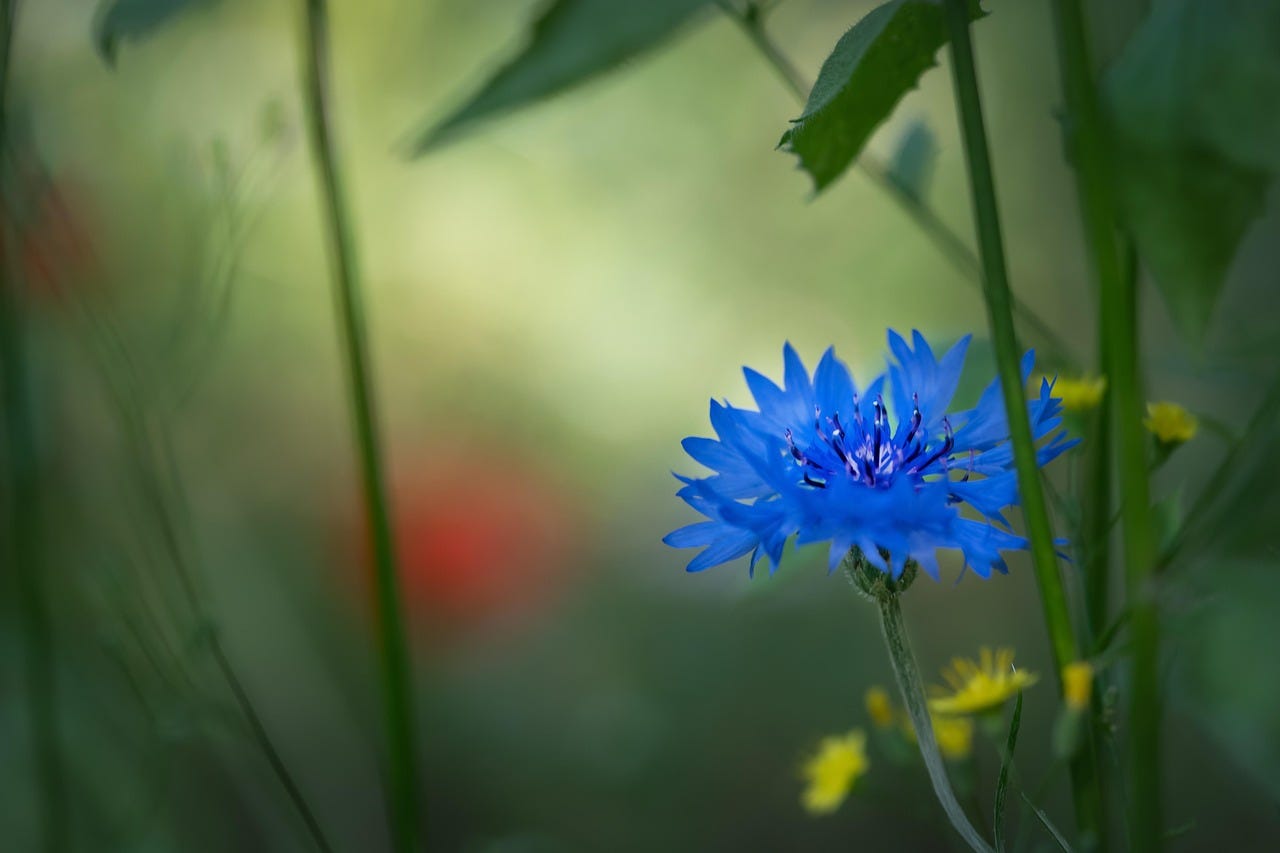
In 1802, Novalis publishes Heinrich von Ofterdingen. At the heart of the novel: a blue flower. The hero searches for it. He does not find it. He cannot find it. The Germans have a word for this desire: Sehnsucht, the longing for what one has never had, a wistful yearning. A blue that rises. That aspires, desires, but transmits nothing.
The Sehnsucht crosses the nineteenth century and changes vehicles. Jules Verne and H. G. Wells redirect this desire toward possible worlds, journeys, machines. The unattainable stops being merely dreamed, it becomes projected. Today, Elon Musk extends the logic in a new form: making elsewhere reachable, transforming the unattainable into a program, a trajectory, a destination.
There is another desire for the inaccessible. This one is found thousands of kilometres from Germany. The blues is born in the cotton fields of the American South, after the abolition of slavery that abolished nothing. The same verse repeated twice, the resolution that resolves nothing. Ralph Ellison, James Baldwin carry this into literature. They knock on a door that does not open.
The blue from below, meanwhile, kept moving.
Wikipedia. Forums. YouTube tutorials. The blue of hyperlinks. That colour signalling everywhere: here, you can go further. The same practical knowledge circulating outside institutional walls, without accreditation, without privilege. It is not a valid source — not according to those who decide what that means. Millions of people learn anyway.
The two blues never mixed. Sehnsucht, Musk, and Mars, for those with the means to desire infinity. Wikipedia, forums, tutorials, for those who fix things themselves because they cannot afford to pay someone else.
Yellow became giallo. White became doctrine. Blue never gave its name to a genre. It circulated unnamed. Without theory. Without legitimacy.
The same colour. Two worlds.
More colours:

