The Author's return
Once certified dead. Now certified authentic.

This text was translated from the original French by Claude (Anthropic).
This is not a defense of artificial intelligence. What interests me here is the gesture we make toward texts.
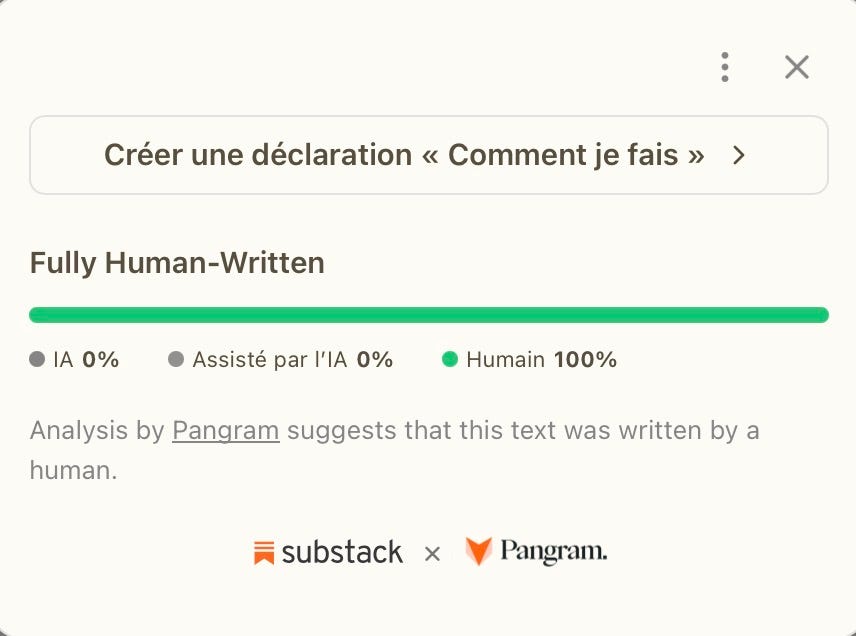
I’m fascinated by the new AI-text detector feature. Its existence rests on an implicit premise: that a text produced by AI is, by principle, inferior.
So why detect it? A reader can perfectly well judge the quality of what they’re reading on their own. Turning to a detector seems to me a tacit admission that the human eye, the human brain, cannot discern a text’s origin — which means quality isn’t what’s actually being judged, in the end. What are we really trying to establish through this detection? Quality, truly, or purity of provenance?
We want to trace a lineage. Establish a genealogy of the text, an unmixed bloodline. The detector doesn’t read, it tracks. It hunts for the trace, the flaw, the hidden sign beneath the surface that would betray an impure origin. A clean text, a pure-stock text, set against the other — the hybrid, the silicon-mixed.
Do we imagine that literature was ever fully pure?
Nineteenth-century serials were sometimes written by several hands. Autobiographies, political speeches, even certain novels were entrusted to writers who worked in secret, whose profession consisted of disappearing behind someone else’s signature. Editors rewrote manuscripts from attic to basement. Novels were finished after their authors died. The ghostwriter has always been tolerated, sometimes even protected by professional secrecy.
Who believes Trump wrote his own memoir alone?
Today, we’re developing tools meant to reveal the slightest intervention by a machine. Why this difference? What, at bottom, bothers us — the collaboration, or the identity of the collaborator?
Since the 1950s, a large part of literary theory has demonstrated the value of shifting our gaze. We were told to set the author aside and focus on the text, then on its reading — and today we seem to want to reverse that movement. Even before reading, our interest turns to the conditions of production, the tools, the percentage of machine and human that supposedly went into making it.
It’s a marking gesture, one we’ve seen before. Before a reader ever encounters the text, it’s already labeled. It no longer presents itself simply as a text, but as an AI text. Judgment precedes reading.
No interest in the text — all the focus on its provenance.
It’s a fantastic paradox for anyone interested in literary theory. We would have spent half a century relativizing the figure of the author, only to arrive at inventing machines to authenticate his presence.
I don’t know whether these detectors actually distinguish texts correctly. What they already reveal, though, is something about our era: we seem less concerned with what a text does than with how it was made.
And I see one more clear irony in this. Having our texts analyzed by an AI to certify their provenance — isn’t that the ultimate hypocrisy? Feeding, in a manner that presents itself as justification, the very machine we’re trying to keep at arm’s length?