

A dove?
Tribute to Rosa Luxemburg

Every Monday, I select an image. A stone, a shadow, or sometimes a reflection: nothing spectacular, just a focal point. This is my way of inviting others to write, of offering something outward and waiting to see what they discern in it.
On Saturday, I return to that image. I share my own creation and the texts received, gathering the echoes of a single light.
This week, the photo is a visual fragment from Jean-Paul Riopelle’s work titled Tribute to Rosa Luxemburg, depicting a bird—a dove with reddish outlines and outstretched wings.
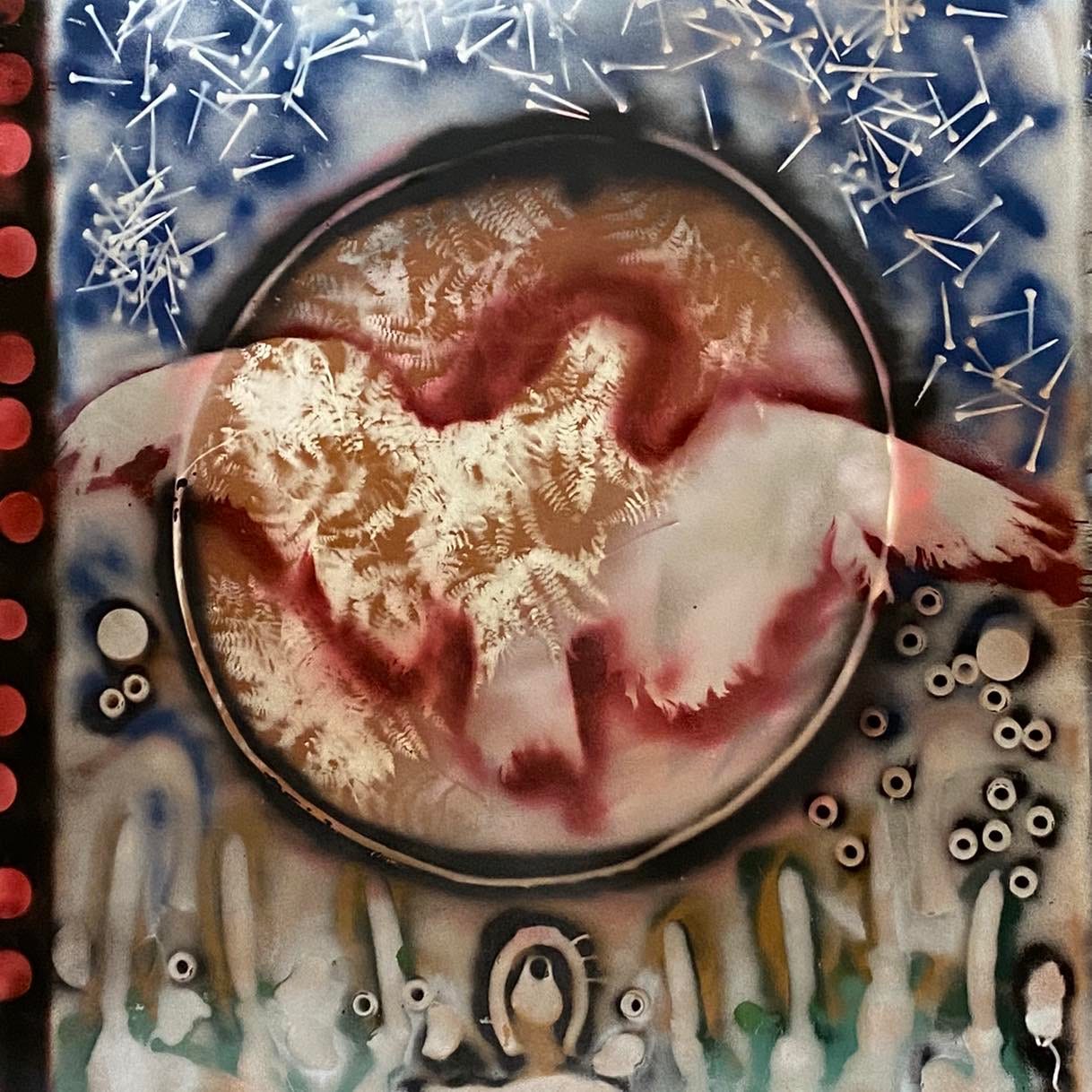
Here is my participation….
Spring 2020 smells of disinfectant and silence. She gazes out the window like it’s an aquarium; people outside move slowly, masked, separated by a distance made mandatory because we’d forgotten how to touch.
On her computer screen, a man calls to his mother. A knee presses into his neck—eight minutes now. She turns off the video. Turns it back on. Turns it off again.
On the table, an open book. An underlined sentence she doesn’t reread.
She thinks of S.
1995—He’d arrived from New York, without papers, with a story the Canadian authorities wouldn’t believe. They shot at me. He said it with the voice of someone who’s repeated the same thing too often and never been believed. She listened, and something in her resisted unconsciously. It wasn’t malicious—it was almost normal. A comfortable skepticism, the kind you can afford when no one’s ever shot at you.
She thought: he’s exaggerating. She thought: paranoia. She didn’t phrase it exactly like that, but it was the undercurrent of her mind. History had granted her that luxury, the privilege of disbelieving what would never touch her.
He knew things she had no inkling of. Other books, other knowledge, a way of reading the world that school hadn’t taught her because it wasn’t her world. He’d shown her how what happens can be read as a conversation between the living and the others. She’d glimpsed it. She hadn’t known what to do with it.
And she’d been surprised that he was intelligent. She hadn’t admitted it that way. But the surprise was real, and surprise always reveals something about the starting assumption… In hindsight, she felt deep shame.
Do you know Queen, Freddie Mercury? she’d dared to ask. He was thirty, fresh from New York. It was 1995. He’d said yes with a politeness that must have cost him. She felt shame about that too.
In the street, he never took her hand. A calm feline, unhurried, with the slow, deliberate gait of someone who occupies space carefully. She found it beautiful. She hadn’t understood it was calculation, the kind History had etched into his body long before he met her. Walking beside a white woman without touching her. Becoming invisible without vanishing. Never seeming to flee a place.
He too bore his chains. I know what your grandparents did to mine. He’d said it one evening, without raising his voice. There was truth in it, and she knew it. But there was also a way of using History as a stage, of turning their bed into a place for settling scores. She’d resisted certain gestures, unsure if it was fear, discomfort, or shame holding her back.
Neither of them was free—not her, not him. History was in the room with them, in the street, in the silence between sentences. It never left.
She’d said no to the child. No to the money she didn’t have. She knew exactly what she was refusing, and it wasn’t him, the man, but everything else. What it would have cost, what she would have become. Keeping your eyes open doesn’t protect you from everything.
The asylum claim was denied, as expected. He left. It took her years to recover from something she couldn’t quite name. Not him exactly, but what they hadn’t managed to be for each other.
In her hand—though she no longer knows for how long—a feather. Found that morning on the balcony. Gray, slightly stained. Probably a pigeon, not a dove, but it feels the same in her palm.
Her daughter sleeps in the next room. She was born four years after S. left. Years later, a Facebook notification: your daughter, is she mine. She hadn’t replied. Some questions don’t need answers.
Outside, someone crosses the street looking over their shoulder. An ancient gesture, a learned one. She watches until he disappears around the corner.
The feather is gray and faintly bloodstained, and she still holds it.
The participations for this week are all in French… counting on some English ones for next week!

